Showing posts with label adrenal adenomas. Show all posts

Monday, March 30, 2009

Cushing's Syndrome in Women With Polycystic Ovaries and Hyperandrogenism

6 responses


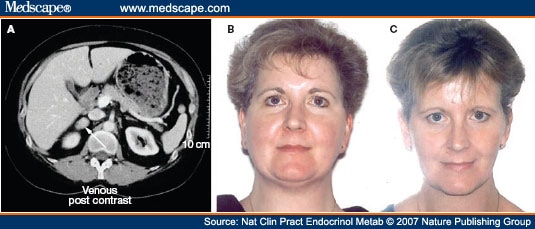
Cushing's Syndrome in Women With Polycystic Ovaries and Hyperandrogenism continues the theme of how to distinguish between PCOS and Cushing's. Above is a picture of a woman who was diagnosed as having PCOS. 7 years later, she was re-tested and found to have Cushing's Syndrome instead.

Cushing's patients are frequently misdiagnosed with PCOS. It is an easy diagnosis (in layman's terms) and avoids the multiple tests and confusion which suspicion of Cushing's seems to bring. This article talks about the aforementioned case and 3 others where Cushing's was misdiagnosed as PCOS. Once treated for the Cushing's, all symptoms which had been attributed to PCOS resolved.

The authors make the case for "the diagnosis of PCOS only when other etiologies have been excluded." They also contend " economic pressures drive health care to be delivered within fewer consultation sessions outside of specialist centers [making it] pertinent to emphasize that not all cases of hyperandrogenism or ovarian cysts are related to PCOS and that curable causes, such as Cushing's syndrome, must be excluded by careful history taking, examination and (potentially repeated) investigation."

And, as a sidenote, the authors mention screening patients who have type 2 diabetes. According to them, "Recent data obtained by screening individuals with type 2 diabetes suggest that cortisol excess, widely considered a rare endocrinopathy in the form of classical Cushing's syndrome, is in fact more common than supposed. "

Saturday, July 5, 2008

Testing 101: An introduction, Part II

0 responses
Yesterday I wrote mainly about pituitary tumors and their hormones, and how they were involved in testing. Today, I want to include information about adrenal tumors.

The adrenal glands sit on top of the kidneys and are sometimes called suprarenal glands. The adrenal gland is actually two glands that are fused together into one gland. Their triangular shape is composed of two main layers as a result: cortex and medulla.

The adrenal medulla produces two main chemicals called catecholamines: epinephrine (also called adrenaline) and norepinephrine. Both of these chemicals are involved in regulation of the nervous system. Epinephrine controls the short-term stress response (aka fight-or-flight response) with the help of norepinephrine, which is also involved in the regulation of mood.

The outer part of the adrenal gland, also called the adrenal cortex, produces steroid hormones that are involved in regulating a number of different body functions. Mineralocorticoids (such as aldosterone) help regulate the salt levels in the body by controlling the absorption and excretion of salt and water in the kidneys which is important in the regulation of blood pressure. Glucocorticoids (such as cortisol) regulate sugar and fat stores within the body, act as a strong anti-inflammatory force, and play an important role in fetal development, particularly in lung maturation. The adrenal cortex also produces several sex steroid hormones, including androgens (critical for male sexual development) and precursors to estrogen (critical for female sexual development).

Tumors of the adrenal glands arise from the cortex or the medulla part of the adrenal gland. Most are found during CT scans or other imaging for various reasons. Others are found due to the effects of the oversecretion of the chemicals or hormones they produce.

A benign tumor called an adrenal adenoma is the most common and is sometimes called an “incidentaloma” if it is not causing any hormonal or chemical oversecretions. However, there is a newer line of research which indicates these are not to be taken lightly and may be a result of other endocrine malfunctions. Marc Slawik and Martin Reincke write in Endotext.com:

In a study patients with incidentalomas who were suffering from subclinical Cushing´s syndrome (SCCS) were significantly more obese (17). In addition, patients with incidentalomas more frequently suffer from diabetes mellitus type 2 (2, 5) and it has been postulated that in these individuals hyperinsulinism leads to an increased proliferation of adrenal cells (25). Taking these findings together there seems to be a clear association of incidentalomas with features of the metabolic syndrome (obesity, arterial hypertension, NIDDM, dyslipidemia, dyscoagulation).

Just this week I linked to a news article which said:

The study, lead by Dr. Leslie Eldeiry, a clinical instructor at Harvard Medical School, which was conducted at Harvard Vanguard Medical Associates, found that"only 30 percent of patients underwent biochemical evaluation for adrenal hyperfunction," which is the production of excessive amounts of hormone.

In 2002, the National Institutes of Health released guidelines recommending hormonal evaluation of all incidentally discovered adrenal masses. Despitethe 2002 NIH recommendations, only 30 percent of patients were properly tested. Moreover only 18 percent of patients in the study who did not see an endocrinologist with adrenal nodules had hormonal testing.

(New Research Indicates That Adrenal Nodules Not Being Adequately Evaluated )

The most common malignant tumors found in the adrenal gland are tumors that come from cancer cells that have metastasized (or spread) from other parts of the body to the adrenal gland through the blood stream.

Rarely, cancers can arise directly within the adrenal glands themselves. Cancers of the adrenal cortex are called adrenal cortical cancers. Functioning adrenal cortical cancers (they secrete excess steroid hormones) are more common than non-functioning cancers.

The most common cancer of the medulla are pheochromocytomas. In children, neuroblastoma tumors can develop within the adrenal medulla.

On my next installment, I'll start talking about some of the testing that is done and what hormones/steroids/chemicals are measured.

Tags

101 (6) 2009 (1) ACTH (3) addison's (2) adenoma (10) adrenal (6) adrenal adenomas (2) adrenal insufficiency (8) adrenalectomy (1) androgens (2) anger (1) animals (1) antibiotic (1) apathy (1) apnea (1) arginine (1) attitude (2) awareness (19) bacteria (1) bariatric (4) bilateral adrenalectomy; zebra (2) BLA (6) blog carnival (1) blogging (1) blogtalkradio (1) blood work (1) buffalo hump (1) cancer (1) carcinoma (1) cardiovascular (2) change (1) chronic (1) chronic illness (8) circadian (2) classical (1) cold (2) conn's (1) cortef (1) corticosteriod (2) cortisol (7) CSF (1) CT scan (1) cure (1) cushing (1) cushing's (77) cyberchondriac (2) cyclic (2) data (1) database (1) death (4) depression (1) dexamethasone (1) diabetes (3) diabetes insipidus (1) diagnose (1) diagnosis (10) disease (1) diurnal (2) doctor (3) doctor blogs (21) doctor friedman (1) doctors (2) doctors google (1) drugs (2) dynamic MRI (2) ectopic (2) education (1) EHR (1) EMR (1) endocrine (5) endocrinology (1) epatients (5) epigenetics (4) epinephrine (1) episodic (2) estrogen (1) familial (2) fat (1) fatigue (1) ferritin (2) florid (1) flu (1) fluid control (1) food (1) gadolinium (2) galactorrhea (1) gamma knife (3) genetics (3) genotropin (1) gland (1) google (1) google health (1) googling (2) grand rounds (4) growth hormone (13) guest post (1) headache (2) health care system (14) health records (4) healthcare (1) HIPAA (1) hirsutism (1) holiday (4) home (1) hoofbeats (1) hormone (1) hormones (5) hormones bioidentical (1) HRT (1) hurt (1) hypercortisolism (1) hyperplasia (1) hypertension (1) hyperthyroidism (2) hypoparathyroidism (1) hypopitiutarism (4) hypothalamus (2) hypothyroidism (7) iatrogenic (1) ice crunching (1) illness (3) imaging (4) immune (1) immunocompromised (1) infection (2) information (2) insurance (2) internet (1) invisible illness (1) iron (1) journey (2) ketoconazole (3) kidney (1) labs (2) lapband (1) laproscopic (1) levaquin (2) libido (1) macroadenoma (2) medical records (2) medical school (1) men (1) metabolic syndrome (3) metamorphosis (1) microadenoma (1) microscopy (1) mild (1) morbidity (2) mortality (1) MRI (2) MRSA (1) mucinex (1) neuroblastoma (1) news (10) night owl (1) nodules (1) norepinephrine (1) obesity (13) obesity hunger willpower (2) Occam's Blade (1) OFM (1) osteoporosis (2) pain (4) parathyroid (3) participatory medicine (2) pasireotide (1) patient rights (2) patients (7) patientsfirst (1) PCOS (6) PCP (1) pediatric (2) peer reviewed (1) percocet (1) personal (1) PET (1) phenotype (1) pheochromoctyoma (1) pheochromocytoma (1) PHR (3) pictures (1) pituitary (24) pituitary surgery (7) pituitary tumor adenoma research acromegaly (1) poll (1) polycystic (2) prolactinoma (1) protein (1) psychological (1) radiation (1) radio; cushing's (2) rant (1) recurrence (1) reform (2) relationships (1) remission (2) research (26) respect (1) retrospective (4) rocephin (1) safari (1) salivary (2) sarcoidosis (1) science (1) serum cortisol (1) shame (1) sick (1) sinus (1) sinus infection (2) sinusitis (1) sleep (2) soda (1) spoon theory (1) steriod (1) steroids (1) subclinical (2) surgery (11) surgeXperiences (2) survival (1) symptom (1) technology (1) temozolomide (1) testing (6) testosterone (2) thyroid (6) to google (1) top10 (1) transsphenoidal endoscopic (1) travel (2) treatment (3) trust (1) tumor (12) twitter (5) urinary free cortisol (2) urinary infection (2) UTI (1) veteran (1) video (3) Vitamin D (6) weakness (1) zebra (5) zippy (1)

Email me....

survivethejourney at gmail dot com

Subscribe via email

Enter your email address:

Delivered by FeedBurner