Dr. Friedman's original PowerPoints may be found at his website. These are very informative and easy to follow.

Showing posts with label cortisol. Show all posts
Showing posts with label cortisol. Show all posts
Saturday, March 28, 2009
Wednesday, November 26, 2008
Audio Interview: How Hormones Influence World Markets on Medgadget
 Cortisol affects the markets, too??

In the current environment [cortisol] may be the more interesting steroid. When the market turns around it turns into a crash what can happen is that cortisol, which is a stress hormone, can become elevated in the bodies of traders. Cortisol, if you're exposed to it chronically at high levels for a long period of time, it can have a devastating effect on both the mind and the body. In terms of affecting traders decisions what it can do is affect the memories you recall. You tend to recall bad memories, negative precedents. You tend to see risk where maybe there is none. You become fearful, you feel anxiety. I think that decreases a trader's appetite for risk. While testosterone is causing people to take too much risk cortisol is causing people to take too little risk in the crash.To hear the interview and read the rest, click here...


Tuesday, August 5, 2008
When the "gold standard" becomes tarnished....
 Urinary Free Cortisol (UFC) testing has long been the "gold standard" for determining the need for more evaluation in the diagnosis of Cushing's Disease/Syndrome (CS). However, recent research belies the paradigm, especially with cyclic/episodic and mild/subclinical CS.
A fairly recent testing protocol, late-night salivary cortisol (NSC), is often touted as a replacement for the late-night serum cortisol. The ease of use at home has made it a practical application for testing cortisol levels. It, too, has limitations in testing for cyclic and/or mild CS.
A third application, the dexamethasone suppression test (DST), is another standard by which practioners evaluate their patients for CS. Again, there are limitations when evaluating cyclic/mild CS.
In a recent study, the full text article examines the three tests mentioned above. They found UFC's were of limited value whe diagnosing "mild" CS.
However, UFC may not accurately reflect the cortisol secretory state in patients with even the modest impairment of renal function (8). In addition, most of the cortisol secreted during a 24-h period is between 0400 h and 1600 h. Subtle increases in nighttime secretion, as may be seen in mild CS, may not be detected or only intermittently detected in a 24-h urine collection.
Notice the majority of the tests fell below the "normal" line on the graph.

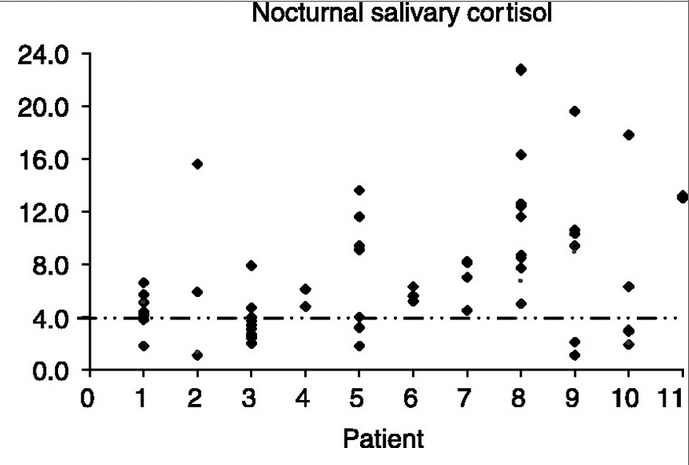
In turn, the NSC was more accurate, but there were many "normals" in the results, with multiple repeats with several patients before obtaining a "high" result. The authors speculate this is due to cyclic CS or a "variability around a mildly elevated set point."
Of the 11 patients evaluated, all had surgery, and 10 of the 11 had pathology proven CS. (Sometimes it is hard to get enough sample tissue for a decent pathology with pituitary surgery.)
The DST was evaluated in this same study with those patients who were tested via that means, but not all patients were. However, in another study, the use of the DST was found to be of limited value for those patients with cyclic/mild CS.
These results demonstrate that the great majority of patients with mild and/or periodic Cushing's syndrome suppress to overnight dexamethasone. Since patients with mild and/or periodic Cushing's syndrome are the patients in whom the identification of hypercortisolism is difficult, our results from this relatively small study suggest that this test should no longer be used to exclude these patients from further workup for Cushing's syndrome.
It is important to remember that no one test adequately evaluates a patient for Cushing's. Even more important, multiple tests may have to be repeated multiple times. The authors in the first article emphasize this when they say, "Obviously [NSC and UFC ] may need to be performed several times before the suspected diagnosis of endogenous hypercortisolism can be correctly identified."
Still a third study (Findling, et al) says, "Even more problematic is the interpretation of the results of these tests, particularly if they are not in agreement with each other. This is particularly so in mild Cushing's syndrome; if the symptoms are subtle, the biochemical abnormalities are likely to be subtle as well." This is a very long article, chock full of information.
How important is it to screen for "mild" CS? "Mild" is a misleading term, sometimes more appropriately called subclinical CS. Findling, et al, point out a huge population where CS is generally overlooked and the depressing mortality for those same folks.
Why is this? Findling lists many reasons, including a study done by Cartagi, et al, where an extraordinarily large percentage of diabetic patients actually had CS. It is often too easy to pin a diagnosis of diabetes or hypertension without realizing it is a symptom.
The recognition of mild/subclinical and cyclic CS has changed the diagnostic approach. Sadly, too many patients are never seen by those who know that.
~~~~~~~~~~~~~~~~~~~~~~
(For more information on how these tests are done, see Testing 101: Biochemical analysis.
For problems/errors to watch for when testing, see When lab tests don't rate an A+, or even a C-..... )
Kidambi, S., Raff, H., Findling, J.W. (2007). Limitations of nocturnal salivary cortisol and urine free cortisol in the diagnosis of mild Cushing's syndrome. European Journal of Endocrinology, 157(6), 725-731. DOI: 10.1530/EJE-07-0424
Saturday, June 28, 2008
One for the money, two for the show, three to make ready....

Just how many kinds of tumors are there associated with Cushing's? Wait, are we talking about pituitary tumors? Or adrenal tumors? How about ectopic tumors? Are you beginning to get the picture of why this illness is so hard to diagnose?
PITUITARY TUMORS/ADENOMAS:
So, let's talk about tumors. These are also sometimes called adenomas. Pituitary adenomas are classified several ways. They may be classified by pathology, by size, and by hormone production. I'm going to keep it simple here and list the basic types of tumors by the hormones they produce. Bear in mind that many pituitary adenomas produce more than one hormone. This production is not held in check by the body's normal feedback loops, thus they aren't controlled.
So, let's talk about tumors. These are also sometimes called adenomas. Pituitary adenomas are classified several ways. They may be classified by pathology, by size, and by hormone production. I'm going to keep it simple here and list the basic types of tumors by the hormones they produce. Bear in mind that many pituitary adenomas produce more than one hormone. This production is not held in check by the body's normal feedback loops, thus they aren't controlled.
- Corticotroph (ACTH-Producing) Adenomas :
The corticotroph adenoma secretes adrenocorticotropic hormone (ACTH), which results in Cushing Disease because it stimulates the adrenal glands to overproduce cortisol. These tumors are initially confined to the sella turcica, but they may enlarge and become invasive especially after bilateral adrenalectomy. This is called Nelson's Syndrome. - Somatotroph (GH-Producing) Adenomas:
Somatotroph adenomas produce growth hormone (GH), resulting in gigantism in younger patients and acromegaly in adults. These tumors may also extend beyond the sella. - Thyrotroph (TSH-Producing) Adenomas:
Thyrotroph adenomas secrete thyroid-stimulating hormone (TSH), also known as thyrotropin, which results in hyperthyroidism without TSH suppression. Many are large and invasive and typically have other types of adenoma cells included, such as ACTH and/or GH. - Lactotroph (PRL-Producing) Adenomas:
Lactotroph adenomas secrete prolactin (PRL) and are typically an intrasellar tumor. However, they can become large enough to enlarge the sella turcica. - Nonfunctioning (Endocrine-Inactive) Adenomas:
These tumors cause symptoms when they extend beyond the sella, which results in pressure on the surrounding structures such as optic nerves and carotid veins. They are not associated with clinical and biochemical evidence of hormone excess. - Carcinomas:
Pituitary carcinomas, although extremely rare, are usually endocrinologically functional, and ACTH-producing and PRL-producing tumors are the most frequent. - Other Tumors:
Other tumors of the pituitary include craniopharyngiomas, meningiomas, and germ cell tumors. Even rarer are the granular cell tumors, pituicytomas, and gangliogliomas. Most rare include gangliocytomas, lymphomas, astrocytomas, and ependymomas.
ADRENAL TUMORS/ADENOMAS:
When a tumor in an adrenal gland overproduces hormones, the tumor is called a functioning tumor. A tumor in an adrenal gland that does not produce hormones is, understandably, called a nonfunctioning tumor. A tumor can start in an adrenal gland (called a primary adrenal tumor) or it can begin in another organ, such as the lungs, and then metastasize (spread) to the adrenal glands. I'm going to focus on primary adrenal gland tumors.
When a tumor in an adrenal gland overproduces hormones, the tumor is called a functioning tumor. A tumor in an adrenal gland that does not produce hormones is, understandably, called a nonfunctioning tumor. A tumor can start in an adrenal gland (called a primary adrenal tumor) or it can begin in another organ, such as the lungs, and then metastasize (spread) to the adrenal glands. I'm going to focus on primary adrenal gland tumors.
- Adenoma:
An adenoma is a benign nonfunctioning tumor of the adrenal cortex. Also called an adrenocortical adenoma, this tumor usually does not cause symptoms, and, if it is small, may not require any treatment. However, as it grows it can put pressure on parts of the gland causing it to under or overproduce hormones. The cause of adrenal adenomas is unknown, but the current accepted theory is that they arise because of mutations in certain genes. Adrenal adenomas are more common in some inherited diseases, including multiple endocrine neoplasia type I, Beckwith-Wiedemann syndrome and the Carney complex.
Chronic adrenal stimulation by ACTH leads to bilateral adrenocortical hyperplasia and, if long-standing, nodular transformation according to recent research. Thus, an ACTH producing tumor of the pituitary or ectopic tumor may stimulate the adrenals to form tumors or become hyperplastic (more about hyperplasia in a bit). - Adrenocortical carcinoma:
Although exceedingly rare this is the most common type of malignant adrenal gland tumor, affecting the cortex, also called an adrenal cortical carcinoma. Adrenocortical carcinoma can be a functioning or nonfunctioning tumor. If the tumor is functioning, it may produce more than one hormone. - Pheochromocytoma:
A pheochromocytoma is a rare tumor that develops in the core of an adrenal gland. It secretes excessive amounts of catecholamines, usually epinephrine and norepinephrine. - Neuroblastoma:
Neuroblastoma is a disease in which malignant cells form in nerve tissue of the adrenal gland. It is very rare.
If that isn't enough, there is another form of tumor that isn't a tumor. It's called hyperplasia. These tumor cells may invade the pituitary or the adrenals in nests throughout the gland. Rather than go in-depth right now, I'll post some links to articles so you can explore the topic:
Pituitary Hyperplasia: A Review
Adrenal Hyperplasia
This is just a basic, no-frills outline of various tumors/adenomas associated with Cushing's Disease. And now....four to go.....to bed, that is....
Pituitary Hyperplasia: A Review
Adrenal Hyperplasia
This is just a basic, no-frills outline of various tumors/adenomas associated with Cushing's Disease. And now....four to go.....to bed, that is....
Friday, June 27, 2008
When "the next episode" takes on new meaning....
Episodic/intermittent/cylical/mild Cushing's has more aliases than a CIA operative. And I'm sure there are some I've left out. Since this form of Cushing's seems to be so elusive to the medical community, the analogy works extremely well. Episodic Cushing’s syndrome (CS) is a rare disorder, characterized by repeated episodes of cortisol excess interspersed by periods of normal cortisol secretion. The so-called cycles of hypercortisolism can occur regularly or irregularly with the phases ranging from days to years.
In comparison, "florid" or "classical" Cushing's shows evidence of continual or almost continual hypercortisolism. There is a school of thought which says these are really very rapidly cycling forms of Cushing's. However, there does not seem to be a concensus on that in the literature and in the research. Frankly, I don't know if anyone has done enough testing daily to figure it out.
According to some research done in the Netherlands, "As with classic hypercortisolism, cyclic CS is found more commonly among women than men, with a female to male ratio of 3:1 (Table 2). The disorder usually becomes manifest in the fifth decade, but may present from early infancy until older age (highest reported age at presentation being 72 years)."
Other clinical studies say, "The features of endogenous hypercortisolism (especially, when mild) are protean and coincide with many common clinical conditions like the dysmetabolic syndrome (1, 2). Screening studies in high-risk populations have discovered unsuspected CS in as many as 2–5% of patients with diabetes mellitus (3–7) and suggest that mild CS is more common than
previously appreciated."
In Cyclical Cushing's syndrome: an update the full text article says, "Cyclical Cushing's syndrome is a pattern of hypercortisolism in which the biochemistry of cortisol production fluctuates rhythmically. This syndrome is often associated with fluctuating symptoms and signs. This type of case was initially thought to be rare. It has, however, recently been recognized as occurring much more frequently. The phenomenon is important because it can, if not recognized, lead to errors in diagnosis and differential diagnosis of the syndrome and in assessment of therapeutic outcomes. All of these can have very serious clinical consequences."
I was told by a prominent endocrinologist at a prominent teaching hospital that "cyclical Cushing's does not exist" and that I was "reading too much" when I was trying to get someone to help me. I hope this person is doing some more reading. S/he is not reading enough.
Stay tuned for the next episode.....
In comparison, "florid" or "classical" Cushing's shows evidence of continual or almost continual hypercortisolism. There is a school of thought which says these are really very rapidly cycling forms of Cushing's. However, there does not seem to be a concensus on that in the literature and in the research. Frankly, I don't know if anyone has done enough testing daily to figure it out.
According to some research done in the Netherlands, "As with classic hypercortisolism, cyclic CS is found more commonly among women than men, with a female to male ratio of 3:1 (Table 2). The disorder usually becomes manifest in the fifth decade, but may present from early infancy until older age (highest reported age at presentation being 72 years)."
Other clinical studies say, "The features of endogenous hypercortisolism (especially, when mild) are protean and coincide with many common clinical conditions like the dysmetabolic syndrome (1, 2). Screening studies in high-risk populations have discovered unsuspected CS in as many as 2–5% of patients with diabetes mellitus (3–7) and suggest that mild CS is more common than
previously appreciated."
In Cyclical Cushing's syndrome: an update the full text article says, "Cyclical Cushing's syndrome is a pattern of hypercortisolism in which the biochemistry of cortisol production fluctuates rhythmically. This syndrome is often associated with fluctuating symptoms and signs. This type of case was initially thought to be rare. It has, however, recently been recognized as occurring much more frequently. The phenomenon is important because it can, if not recognized, lead to errors in diagnosis and differential diagnosis of the syndrome and in assessment of therapeutic outcomes. All of these can have very serious clinical consequences."
I was told by a prominent endocrinologist at a prominent teaching hospital that "cyclical Cushing's does not exist" and that I was "reading too much" when I was trying to get someone to help me. I hope this person is doing some more reading. S/he is not reading enough.
Stay tuned for the next episode.....
Thursday, June 26, 2008
What is Cushing's Disease?
 I have been asked that umpteen times by folks who care about me. Other folks just look at me like I'm from an alien planet, and even others just nod and go on like they already know. I'm sure they go right home and google it. Ok, maybe some of them do.
When you get right down to it, I've become a walking library of sorts with facts and figures most medical students and doctors don't know. It's a matter of self-preservation, but you already know that if you are fighting any illness.
So, what is Cushing's? There are two terms used with Cushing's: Disease and Syndrome. They signify the source of the illness, although the presentation is pretty much the same with both. Cushing's Disease is hypercortisolism due to a pituitary source of stimulation. Cushing's Syndrome is hypercortisolism due to an ectopic or adrenal source. There really is a third type of Cushing's called iatrogenic Cushing's which results from the overuse of corticosteriod medications. And actually another type called pseudo-Cushing's.
I want to discuss Cushing's Disease/Syndrome (CD/CS). CD/CS is an endocrine disorder caused by chronic exposure of the body's tissues to excess levels of cortisol - a hormone naturally produced by the adrenal gland. Pituitary adenomas, usually benign, secrete increased amounts of ACTH (adrenocorticotropic hormone), a substance that controls the release of cortisol in that feedback loop I mentioned the other day. It typically causes an overproduction of cortisol. Tumors of the adrenal gland and ectopic ACTH producing tumors can cause similar problems with cortisol overproduction.
What are the symptoms? The most common symptoms are:
- Striae
- Buffalo hump
- red-faced all the time
- sweaty or hard to control body temp
- High blood pressure (often hard to control even with medication)
- High blood sugars and/or insulin resistance
- Insomnia
- Fatigue
- Altered diurnal rhythm (See previous post)
- Secondary hypothyroidism
- Low hormones such as FH, LSH, testosterone, growth hormone
- Low Vitamin D
- Low ferritin
- Unexplained muscle, bone, and joint pain
- Easy bruising
- Difficulty when drawing blood
- Upper body obesity
- Muscle weakness
- Increased facial hair/body hair (hirsutism)
- Loss of hair on head
- Loss of menstrual cycle and/or ovulation
- Loss of libido
- galactorrhea
Not everyone has all the symptoms. And the weight gain can vary by individual. Some folks don't gain a lot. Others do.
Without prompt treatment for Cushing's syndrome, other complications may occur, such as:
- Bone loss (osteoporosis), due to the damaging effects of excess cortisol
- High blood pressure (hypertension)
- Kidney stones
- Diabetes
- Unusual infections
- Hypothyroidism
When the cause of Cushing's syndrome is a pituitary tumor (Cushing's disease), it can sometimes lead to other problems, such as interfering with the production of other hormones that the pituitary controls. It can also affect the optic nerves and carotid arteries if large. The majority of pituitary tumors that cause Cushing's disease are small (less than one cm in size).
Morbidity and mortality are higher in patients with Cushing's disease, with vascular disease a frequent cause of death.[2,32,33] Cardiovascular complications, including coronary heart disease, congestive heart disease and cerebrovascular events, contribute to the morbidity and mortality of patients with undiagnosed or untreated Cushing's disease.[34,35] Early diagnosis and successful treatment of Cushing's disease is therefore most important.
Now, diagnosis....that's a whole 'nuther ballgame. To mix metaphors, it is no walk in the (ball)park.
Wednesday, June 25, 2008
When cortisol is a night owl....
What ARE you talking about, Robin? I can hear it now. Yes, we hear a lot about cortisol and how lowering it by lowering stress can affect our weight. I'm sure you've seen the ads for the cortisol-slimming drugs/herbs, too. And we are talking about the same hormone. What is cortisol, anyway?
Cortisol is a corticosteroid hormone produced by the adrenal cortex, the outer layer of the adrenal glands which are essentially lying on top of the kidneys. Without it we die. It is the hormone that responds to "stress", both good and bad. It affects levels of multiple other hormones and electrolytes, which is another topic for another day. However, the short of it is, it is very important in the homeostasis of the body.
When the body is functioning normally, cortisol is regulated by the pituitary in a negative feedback loop with ACTH (adrenocorticotropic hormone). Basically, the pituitary produces ACTH when the body's cortisol level is low, which stimulates the adrenals to produce cortisol. ACTH is pulsatile, which means it is produced in spurts instead of evenly or consistently.
What does all this have to do with cortisol being a night owl?
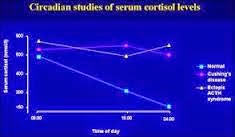
In a "normal" person, cortisol is the highest around 8 a.m. and decreases to about half that value around 4 p.m. By midnight (give or take an hour each way), cortisol should be about zero or close to it with blood and salivary levels. This is a normal diurnal variation. It is also called the circadian rhythm.
When one has Cushing's, this circadian rhythm is lost, and the normal diurnal variation changes. Cushing's patients have "flat" diurnal levels of cortisol, or even higher levels at night instead of in the morning.Endotext.com explains it really well. Their diagram shows the difference between normal serum cortisol levels and the levels for those who have Cushing's. (Click on the link or the picture to see it better.)
Where does that take us? Well, to testing. Because of this change from normal to warped diurnal rhythm (or lack of), testing cortisol levels can be very useful when diagnosing Cushing's Syndrome/Disease.
The article, "Cushing's Syndrome" by John Newell-Price, Xavier Bertagna, Ashley B Grossman, Lynnette K Nieman, Lancet 2006; 367: 1605–17,Division of Clinical Sciences, University of Sheffi eld, Northern General Hospital, Sheffi eld, UK (J Newell-Price FRCP); says:
Midnight plasma cortisol or late-night salivary cortisol: Normal circadian rhythm of cortisol secretion is lost in patients with Cushing’s syndrome. A single sleeping midnight plasma cortisol concentration of less than 50 nmol/L effectively excludes Cushing’s syndrome at the time of the test and this might be especially helpful in patients in whom there has been incomplete suppression on dexamethasone testing. Concentrations of more than 50 nmol/L are noted in individuals with Cushing’s syndrome, even those who suppress serum cortisol on low-dose dexamethasone testing,96 but this cutoff lacks specificity because patients with acute illness also have values above this concentration. An awake midnight concentration of cortisol in plasma of more than 207 nmol/L diff erentiates between Cushing’s syndrome and other causes of hypercortisolaemia but can miss mild disease diagnosis in about 7% of cases. (The conversion factor of ug/dL x 27.6 = nmol/L)
So, being a night owl doesn't make you "Cushie", but if you are Cushie, you probably are a night owl. Of course, that brings us to yet another topic for another day....cyclical/intermittent/episodic Cushing's.
Cortisol whoooooooooooooooooooooooooooo.........???
Subscribe to:
Posts (Atom)

