Showing posts with label PCOS. Show all posts

Wednesday, September 23, 2009

U.Va. gets $7 million grant to study polycystic ovary syndrome

0 responses
U.Va. gets $7 million grant to study polycystic ovary syndrome
Staff Reports • September 21, 2009

"Childhood obesity has been blamed for a number of medical conditions affecting too many American children. Researchers at the University of Virginia School of Medicine have received a $7 million U54 Center Grant from the National Institutes of Health to examine yet another condition believed to be related to obesity: polycystic ovary syndrome..."

"We already know that signals coming from the brain and the pituitary gland to the ovaries are abnormal in girls with too much testosterone," Marshall said. "Now we have to prove that the high levels of testosterone are present before puberty and if these high levels affect the way girls go through puberty. Then we hope to learn how to prevent it from occurring."


To read more Click here

Monday, June 15, 2009

PCOS is not the only reason for androgen-excess

1 responses
Polycystic ovarian syndrome (PCOS) is often a convenient diagnosis for many actually suffering with other endocrine disorders. Cushing's patients are frequently misdiagnosed with PCOS. It is an easy diagnosis (in layman's terms) and avoids the multiple tests and confusion which suspicion of Cushing's seems to bring. In a previous post, I wrote about 4 cases of Cushing's misdiagnosed as PCOS. Once treated for the Cushing's, all symptoms which had been attributed to PCOS resolved.

A new article in the New England Journal of Medicine, Inactivating PAPSS2 Mutations in a Patient with Premature Pubarche, the authors show that "PAPSS2 deficiency should be added to the list of defined causes of androgen excess that must be ruled out before diagnosing the polycystic ovary syndrome."

There are two isozymes encoded by genes located on chromosome 4 (PAPS synthase 1) and chromosome 10 (PAPS synthase 2, also abbreviated as PAPSS2) which are important in the sulfation of DHEA to DHEAS. DHEA is a precursor to androgens, and when the sulfation to DHEAS can not take place, the authors hypothesize this leads to androgen excess. They present the case of an 8 year-old girl with "premature pubarche, hyperandrogenic anovulation, very low DHEAS levels, and increased androgen levels." They determined she had a genetic defect which caused a loss of PAPSS2 activity. It is still unclear why the PAPSS1 enzyme did not compensate for that.

The article is well-written, very thorough, and full of graphs, pictures, and diagrams. It explains how they followed this young lady for several years, the studies they did, and the testing that was done. It also begs the question of diagnosing PCOS due to androgen excess. PAPSS2 deficiency appears to be a genetic adrenocortical cause of androgen excess.


Noordam C, Dhir V, McNelis JC, Schlereth F, Hanley NA, Krone N, Smeitink JA, Smeets R, Sweep FC, Claahsen-van der Grinten HL, Arlt W. (2009). Inactivating PAPSS2 mutations in a patient with premature pubarche New England Journal of Medicine, 360 (22), 2310-2318 PMID: 19474428


To read more:

Distinguishing PCOS and Cushing's: Does testosterone tell the tale?

Cushing's Syndrome in Women With Polycystic Ovaries and Hyperandrogenism

Monday, March 30, 2009

Cushing's Syndrome in Women With Polycystic Ovaries and Hyperandrogenism

6 responses


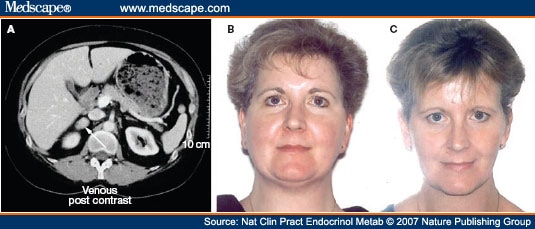
Cushing's Syndrome in Women With Polycystic Ovaries and Hyperandrogenism continues the theme of how to distinguish between PCOS and Cushing's. Above is a picture of a woman who was diagnosed as having PCOS. 7 years later, she was re-tested and found to have Cushing's Syndrome instead.

Cushing's patients are frequently misdiagnosed with PCOS. It is an easy diagnosis (in layman's terms) and avoids the multiple tests and confusion which suspicion of Cushing's seems to bring. This article talks about the aforementioned case and 3 others where Cushing's was misdiagnosed as PCOS. Once treated for the Cushing's, all symptoms which had been attributed to PCOS resolved.

The authors make the case for "the diagnosis of PCOS only when other etiologies have been excluded." They also contend " economic pressures drive health care to be delivered within fewer consultation sessions outside of specialist centers [making it] pertinent to emphasize that not all cases of hyperandrogenism or ovarian cysts are related to PCOS and that curable causes, such as Cushing's syndrome, must be excluded by careful history taking, examination and (potentially repeated) investigation."

And, as a sidenote, the authors mention screening patients who have type 2 diabetes. According to them, "Recent data obtained by screening individuals with type 2 diabetes suggest that cortisol excess, widely considered a rare endocrinopathy in the form of classical Cushing's syndrome, is in fact more common than supposed. "

Sunday, March 29, 2009

Distinguishing PCOS and Cushing's: Does testosterone tell the tale?

0 responses
Cushing's Syndrome (CS) has been considered rare, but thoughts are changing about that. This article notes that fact, pointing out "most published articles on CS have examined patients with sustained and severe hypercortisolism." It also points out the increased recognition of the prevelance of "mild" and "episodic" CS which have both normal and high values with testing. (Image source)

CS and polycystic ovarian syndrome (PCOS) present similarly, but are treated much differently.
Both diseases can present with weight gain, hirsutism, acne, and irregular periods in women. However, CS usually includes symptoms such as easy bruising, sleep disturbances, decreased libido, a buff alo hump, and stretch marks, which are not present in PCOS. Women with mild and/or periodic CS, however, can be difficult to diagnose as they may lack classic manifestations of the disease and the diagnosis may require multiple hormonal measurements [4, 5, 7] . The treatment of CS is primarily the surgical removal of a pituitary, adrenal, or ectopic tumor. The treatment for PCOS is primarily medical and includes oral contraceptives, biguanides (metformin), thiazolidinediones (rosiglitazone or pioglitazone) or androgen antagonists (spirolactone or flutamide) [8] . Thus, distinguishing the two conditions is important.
This study used women who, under the 1990 NIH criteria, have PCOS. These were compared to women who had been diagnosed with mild CS due to a pituitary adenoma. The study goes into great detail about the criteria for each set.

The authors hypothesized "either total testosterone (TT) or bioavailable testosterone (BT) levels or the calculation of the free androgen index (FAI) would be low in patients with mild CS and elevated in patients with PCOS, and could help differentiate the two conditions." According to their statistical analyses:


Total testosterone gave the highest sensitivity, positive predictive value (PPV)and negative predictive value (NPV) while BT gave the highest specifi city for the diagnosis of CS. Determinations AUC demonstrate that use of a TT level gave “ good ” diagnostic accuracy, while BT and FAI gave “ fair ” diagnostic accuracy.
The authors emphasize "[m]ost commercial assays lack the accuracy and precision of assays when measuring testosterone in women, as recently reviewed in an Endocrine Society position statement [35]". They used mass spectroscopy analysis done at Esoterix Laboratories. They also determined there is overlap between the two groups when dexamethasone suppression is used due to the mild/cyclic nature of these CS patients. Most of all, the phenotypes between the two groups may be similar. Testosterone analysis, when using an accurate and precise assay at a validated laboratory, may be another tool to distinguish between the two.

Note: There are some great graphs and charts in the full-text article. It is well worth perusing. My previous post has some of them included in the first scribd presentation by Dr. Friedman.

Pall, M., Lao, M., Patel, S., Lee, M., Ghods, D., Chandler, D., & Friedman, T. (2008). Testosterone and Bioavailable Testosterone Help to Distinguish between Mild Cushing's Syndrome and Polycystic Ovarian Syndrome Hormone and Metabolic Research, 40 (11), 813-818 DOI: 10.1055/s-0028-1087186

Sunday, March 8, 2009

What's the real deal about Metabolic Syndrome?

3 responses

The other day Dr. Rob, who blogs at Musings of a Distractible Mind, tweeted about a patient he had seen that day. He asked for input and wow, did he get it! I promised some information via this blog a the end of the discussion. Thus, this post, which will continue after the dialog.

To get the gist of the dialog, you must start at the bottom and read up. I may have missed some tweets about his original statement and I apologize if so. I tried to find them all.


staticnrg
04:33 PM Mar 06, 2009
@doc_rob I'll include this, too. I'm loaded for bear. ;) (reference to PCOS statement made by doc_rob)

staticnrg
04:32 PM Mar 06, 2009
@doc_rob Too much to tweet about. Will blog about it and post URL this weekend.

doc_rob
04:28 PM Mar 06, 2009
@staticnrg I can see how Low-grade cushings will present as Met Synd. That does not = Metabolic syndrome is low-grade cushings.

doc_rob
04:27 PM Mar 06, 2009
@staticnrg Skeptical. Show me the research. Genetics strongly tied to type 2 DM. Related to Polycystic ovaries as well.

staticnrg
04:25 PM Mar 06, 2009
@doc_rob No...beg to differ. Remove cause of hypercortisolism which causes met syndrome (insulin resistance). Treat cause, not symptom

doc_rob
04:21 PM Mar 06, 2009
@staticnrg Perhaps, but for practical purposes, the treatment is to use a "typical" Metabolic syndrome approach. Insulin resistance is root

staticnrg
04:19 PM Mar 06, 2009
@doc_rob Research now says met syndrome a symptom of subclinical Cushing's

doc_rob
04:14 PM Mar 06, 2009
@staticnrg Seeing all comers (as I do), Met. Syndrome is REALLY common. At best, cushings is 1% of the cases.

staticnrg
03:51 PM Mar 06, 2009
@doc_rob Blunt again: statistics are wrong, but slowly being changed. New research/literature does that.

doc_rob
03:50 PM Mar 06, 2009
@staticnrg Yeah, but most metabolic syndrome is hyperinsulinism due to wt, etc. If he was 50, I'd just assume - Just statistic likelihood.

staticnrg
03:48 PM Mar 06, 2009
@doc_rob Gonna be blunt: metabolic syndrome is a catch-all. Many w/Cushing's get shunted into that. You are wonderful PCP for testing. :)

staticnrg
03:40 PM Mar 06, 2009
@staticnrg Have articles if you want them. Can email.

doc_rob
03:36 PM Mar 06, 2009
@staticnrg Normal K (was talking about Conn's - Aldosterone Deficiency). I do Urine Metanephrines for pheo screening. - Follow UpToDate rec

staticnrg
03:27 PM Mar 06, 2009
@doc_rob @ARUPlabs has great site for tests. http://bit.ly/1upxeW

doc_rob
03:36 PM Mar 06, 2009
@staticnrg Normal K (was talking about Conn's - Aldosterone Deficiency). I do Urine Metanephrines for pheo screening. - Follow UpToDate rec

staticnrg
03:27 PM Mar 06, 2009
@doc_rob @ARUPlabs has great site for tests. http://bit.ly/1upxeW

laikas
03:27 PM Mar 06, 2009
@doc_rob Googling 4 Pheochromocytoma + glucose + triglycerides gives many results: http://is.gd/mcjU - just confirms. Will look up Williams

staticnrg
03:24 PM Mar 06, 2009
@laikas @doc_rob Pheo has to be caught when "on". Test for plasma free metanephrines, I believe.

staticnrg
03:21 PM Mar 06, 2009
@doc_rob What @laikas said. I could have "normal" K (low end), then days later have very low K and end up in ER. Other hormones off?

laikas
03:20 PM Mar 06, 2009
@doc_rob But Elevated blood glucose level + high triglycerides (+HBP of course) occur in Pheochromocytoma. Wikipedia :) : http://is.gd/iQ8y

laikas
03:16 PM Mar 06, 2009
@doc_rob Bc of storage of K in muscles low K doesn't always show in blood until a late stage. =safeguard. Almost never abnormal Na in Conn.

doc_rob
03:11 PM Mar 06, 2009
@laikas Conn's yes, but BMP with normal Na, K. makes mineralcorticoid less likely.

doc_rob
01:59 PM Mar 06, 2009
@cushings Well, cushings certainly needs to be ruled out in this circumstance. I think of my cushings pals when I see things like this.

cushings
01:56 PM Mar 06, 2009
@doc_rob sounds like Cushing's in dogs again! Hope he doesn't have it

KidneyNotes
01:31 PM Mar 06, 2009
@doc_r0b Sounds like someone taking prednisone, an unlikely drug of abuse.

KidneyNotes
01:29 PM Mar 06, 2009
@doc_rob Renal artery stenosis...

doc_rob
01:26 PM Mar 06, 2009
@joemd Thanks.

joemd
01:21 PM Mar 06, 2009
@doc_rob Got it. Urine tox screen might help. Love your avitar. :-)

doc_rob
01:19 PM Mar 06, 2009
@joemd This is not real acute - New patient here a month ago with abnormal labs. Today came in with higher BP. Seen by Nephrology alreday

joemd
01:18 PM Mar 06, 2009
@doc_rob Other possibilities: migrane, ruptured aneurysm, other CNS stuff. Head CT? MRI?

joemd
01:17 PM Mar 06, 2009
@doc_rob Yes (cocaine, etc.). Also can see serotonin syndrome with antidepressants (SSRIs, SNRIs, Tricyclics...). Also EtOH w/d

doc_rob
01:14 PM Mar 06, 2009
@joemd None. I am also wondering about drugs.

joemd
01:13 PM Mar 06, 2009
@doc_rob Is he on an antipsychotic (metabolic syndrome)? If so, neuroleptic malignant syndrome?

doc_rob
01:12 PM Mar 06, 2009
not fur, for - he does not have Fur cushings.

doc_rob
01:11 PM Mar 06, 2009
Workup includes Check fur cushings, insulin resistance, renal problems. Anything I am missing?

doc_rob
01:10 PM Mar 06, 2009
Teenage boy with HTN, Headache, Elevated Blood Sugar, Triglycerides - Metabolic Syndrome picture. Strong genetics, but BP very high.


My intent with this post was to verify for Dr. Rob and others what I said briefly in my tweets. However, it has evolved into so much more than that. I have tried to be as brief as possible yet give enough concrete information (with resources) to validate my statements.

A brief history of the term "metabolic syndrome" helps one to understand the rest of the post. Dr. Gerald Reaven (Stanford University) proposed the “syndrome X” concept in 1988, but the term "Metabolic Syndrome" was coined in 1998 by the World Health Organization, and thus made popular.

In The Metabolic Syndrome: Time for a Critical Appraisal (Joint statement from the American Diabetes Association and the EuropeanAssociation for the Study of Diabetes), the popularity of the terminology is explained:

It has been defined and institutionalized, principally by the World Health organization(WHO) (26) and the Third Report of the National Cholesterol Education Program’s Adult Treatment Panel (ATPIII) (27,28), albeit with different definitions. In addition, other organizations have developed similar, but again not identical, definitions (29,30). The fact that a version of the metabolic syndrome has its own ICD-9 code (277.7) also suggests that it is well thought out (31,32).

However, the article continues with explanations of how this happened and reasons why the term is not a valid one:

In summary, the attempt to define themetabolic syndrome as the result of a single (or even major) unifying pathophysiological process, e.g., insulin resistance, is problematic. Although insulin resistance or hyperinsulinemia is clearly an important feature of the syndrome, many other as yet unidentified factors are also important. Insulin resistance may simply be one of many abnormalities linked to a more fundamental, truly unifying pathophysiology. Moreover, the definition of the syndrome includes risk factors that are only weakly related to insulin resistance or hyperinsulinemia (e.g., blood pressure) and excludes others that are closely related(e.g., CRP, adiponectin). Finally, although many clinical values are significantly associated with insulin resistance/hyperinsulinemia, the strength of their association (which has not exceeded acorrelation coefficient of 0.7 and is usually0.3– 0.6) is not
particularly impressive.

As the article continues, the authors show how there is little to no valid data to show how the old or new definitions actually have any benefit to the diagnosis and treatment of patients. In fact, they contend there is "much fundamental, clinically important,and critically missing information about the metabolic syndrome ...a presumed disease that does not stand on firm ground. [P]atients with diabetes or clinical CVD should be excluded from the case definition of metabolic syndrome, as they provide no additional understanding of risk or treatment recommendations that are otherwise not currently recommended."

According to Clinical Use of the Metabolic Syndrome: Why the Confusion? , there several factions vying for the conclusive definition of metabolic syndrome. The issue, though, is the change of the terminology from a pathophysiological approach to a clinical definition defined by an ICD-9 code (277.7). With multiple factions offering different perspectives, the article offers a requiem, "given the seemingly arbitrary clinical definitions and the uncertain clinical utility, the metabolic syndrome should be declared dead".

Even Reaven, who first coined the term "Syndrome X" which later became "metabolic syndrome", published an article recently: The Metabolic Syndrome: Requiescat in Pace . \

Professor Edwin A M Gale of even more recently wrote Should we dump the metabolic syndrome?: Yes. He says, "Diagnosis of the metabolic syndrome is redundant in those who already have diabetes and adds nothing to the management of those who do not. "

He continues, "This is not a turf war: the confrontation reflects genuine perplexity within the diabetes community. One party maintains that a working definition is needed to resolve existing confusion; the other party argues that an inadequate definition merely adds to it. "

Dr. Gale alleges the use of "metabolic syndrome" is outdated and outperformed by other scoring systems which treat "continuous variables as continuous, whereas the metabolic syndrome treats them as dichotomous." He emphatically says, "the metabolic syndrome is a handy clinical label that lacks a useful definition."

Assuming the aforementioned "metabolic syndrome" is not declared dead, what is its value? Is it merely a set of symptoms which are part of a bigger whole or not actually related at all?

In Is the "Metabolic Syndrome" a Mild Form of Cushing's Syndrome? The Curious Story of 11beta-Hydroxysteroid Dehydrogenase, Dr. Ashok Balasubramanyam explores the role of 11beta-HSD (types 1 and 2). (There is a lot of current research ongoing with 11beta-HSD, easily found by using the term in PubMed and other medical search engines.)

Dr. Balasubramanyam elaborates:

One intriguing question is: Could a single primary defect trigger a cascade of diverse events leading to these apparently disparate metabolic, cardiovascular, and reproductive defects? Since Cushing's syndrome also encompasses many of these disorders, it is worthwhile considering whether the metabolic syndrome could be a "forme fruste" of Cushing's.

In Glucocorticoids, metabolism and metabolic diseases (full text version), the author states:

Indeed, hyperactivity of the HPA axis is positively correlated with the metabolic
syndrome as demonstrated in subjects with glucose intolerance, hypertension, and
insulin resistance (Reynolds et al., 2001a,b; Phillips et al., 1998; Phillips et al.,2000; Walker et al., 1998), suggesting a causative role for [glucocorticosteriods] in the obese phenotype...Taken together, increased GC levels or sensitivity in muscle have been associated with conditions related to the metabolic syndrome in several studies and models.

In Cortisol--cause and cure for metabolic syndrome? (full text version), the author makes the case for the similarity of metabolic syndrome and Cushing's syndrome.

Similarities between the metabolic syndrome and Cushing's syndrome, and reversibility of the features of Cushing's syndrome, suggest that cortisol may contribute to the pathophysiology of both conditions and that reducing cortisol action may provide a novel therapeutic approach in the metabolic syndrome...

...We have collected evidence that the HPA axis is ‘activated’in the metabolic syndrome. In cohort studies, we have shown that 09.00 h plasma cortisol after overnight fasting is elevated in subjects with relative glucose intolerance, hypertension, insulin resistance and hypertriglyceridaemia (Fig. 1) [2–6].This elevation of plasma cortisol in metabolic syndrome associates with increased cortisol response to low-dose (1μg)ACTH1−24, consistent with adrenal hypertrophy [7]. Integrated cortisol secretion, measured using mass spectrometry to assess total urinary cortisol metabolite excretion, is variably increased in subjects with the metabolic syndrome.

I have much, much more information, but shall save it for another post later this week. I hope to tie in information about PCOS, also.



Wednesday, June 4, 2008

A horse of a different color

0 responses
Or should I say zebra? In med school, potential doctors are told ""When you hear hoofbeats, think horses, not zebras". Well, what about those of us who are zebras? What does that say to those who don't fit any mold of illness or have multiple illnesses which paint stripes?

As I said earlier, my primary care doctor sees horses, but every now and then she does notice a stripe. The thing is, she tries to get rid of the stripe instead of looking at what caused it. And she's not alone. Frankly, I'm wondering if there really are any horses out there? Ok...ok....I guess there are. Maybe.

Diabetes, you say, is a horse. Nope.... Did you know that endocrine disease can cause it? And that it is just a secondary symptom? You didn't know that? Don't worry. Most endocrinologists don't seem to, either. Thankfully, I never had that particular stripe.

Ok, how about thyroid function/disease? Nope, not that one either. It's actually a stripe in the zebra of endocrine disease, especially a pituitary tumor. Secondary/central hypothyroidism is linked to a pituitary tumor suppressing the pituitary, and hyperthyroidism can be linked to a TSH producing tumor.

Low hormones? Oh, that must be early menopause or pre-menopause with females, right? Wrong. Just stripes of another color in the zebra of pituitary tumors.

How about high hormones? Well, guess what? Do I need to say it? More stripes...... Pituitary adenomas are famous for growth hormone and ACTH overproduction.

PCOS and metabolic syndrome are often the horses with which a Cushing's patient is diagnosed. Too often, it's just too easy to camouflage the stripes with those diagnoses.

Oh, and my favorite. Obesity. "You need to eat less and get more exercise." How many people do you know who want to be extremely overweight? Those doctors who don't listen, ignore the stripes (some literal ones called striae) and keep repeating that mantra need a A Swift Kick in the ASP. They don't know that fat is an endocrine organ. They also don't know it is actually possible to literally starve while remaining obese.

I do not know the answers. I do know there is a problem. Instead of heading to the dude ranch, maybe med schools ought to take their future doctors on a safari.

Tags

101 (6) 2009 (1) ACTH (3) addison's (2) adenoma (10) adrenal (6) adrenal adenomas (2) adrenal insufficiency (8) adrenalectomy (1) androgens (2) anger (1) animals (1) antibiotic (1) apathy (1) apnea (1) arginine (1) attitude (2) awareness (19) bacteria (1) bariatric (4) bilateral adrenalectomy; zebra (2) BLA (6) blog carnival (1) blogging (1) blogtalkradio (1) blood work (1) buffalo hump (1) cancer (1) carcinoma (1) cardiovascular (2) change (1) chronic (1) chronic illness (8) circadian (2) classical (1) cold (2) conn's (1) cortef (1) corticosteriod (2) cortisol (7) CSF (1) CT scan (1) cure (1) cushing (1) cushing's (77) cyberchondriac (2) cyclic (2) data (1) database (1) death (4) depression (1) dexamethasone (1) diabetes (3) diabetes insipidus (1) diagnose (1) diagnosis (10) disease (1) diurnal (2) doctor (3) doctor blogs (21) doctor friedman (1) doctors (2) doctors google (1) drugs (2) dynamic MRI (2) ectopic (2) education (1) EHR (1) EMR (1) endocrine (5) endocrinology (1) epatients (5) epigenetics (4) epinephrine (1) episodic (2) estrogen (1) familial (2) fat (1) fatigue (1) ferritin (2) florid (1) flu (1) fluid control (1) food (1) gadolinium (2) galactorrhea (1) gamma knife (3) genetics (3) genotropin (1) gland (1) google (1) google health (1) googling (2) grand rounds (4) growth hormone (13) guest post (1) headache (2) health care system (14) health records (4) healthcare (1) HIPAA (1) hirsutism (1) holiday (4) home (1) hoofbeats (1) hormone (1) hormones (5) hormones bioidentical (1) HRT (1) hurt (1) hypercortisolism (1) hyperplasia (1) hypertension (1) hyperthyroidism (2) hypoparathyroidism (1) hypopitiutarism (4) hypothalamus (2) hypothyroidism (7) iatrogenic (1) ice crunching (1) illness (3) imaging (4) immune (1) immunocompromised (1) infection (2) information (2) insurance (2) internet (1) invisible illness (1) iron (1) journey (2) ketoconazole (3) kidney (1) labs (2) lapband (1) laproscopic (1) levaquin (2) libido (1) macroadenoma (2) medical records (2) medical school (1) men (1) metabolic syndrome (3) metamorphosis (1) microadenoma (1) microscopy (1) mild (1) morbidity (2) mortality (1) MRI (2) MRSA (1) mucinex (1) neuroblastoma (1) news (10) night owl (1) nodules (1) norepinephrine (1) obesity (13) obesity hunger willpower (2) Occam's Blade (1) OFM (1) osteoporosis (2) pain (4) parathyroid (3) participatory medicine (2) pasireotide (1) patient rights (2) patients (7) patientsfirst (1) PCOS (6) PCP (1) pediatric (2) peer reviewed (1) percocet (1) personal (1) PET (1) phenotype (1) pheochromoctyoma (1) pheochromocytoma (1) PHR (3) pictures (1) pituitary (24) pituitary surgery (7) pituitary tumor adenoma research acromegaly (1) poll (1) polycystic (2) prolactinoma (1) protein (1) psychological (1) radiation (1) radio; cushing's (2) rant (1) recurrence (1) reform (2) relationships (1) remission (2) research (26) respect (1) retrospective (4) rocephin (1) safari (1) salivary (2) sarcoidosis (1) science (1) serum cortisol (1) shame (1) sick (1) sinus (1) sinus infection (2) sinusitis (1) sleep (2) soda (1) spoon theory (1) steriod (1) steroids (1) subclinical (2) surgery (11) surgeXperiences (2) survival (1) symptom (1) technology (1) temozolomide (1) testing (6) testosterone (2) thyroid (6) to google (1) top10 (1) transsphenoidal endoscopic (1) travel (2) treatment (3) trust (1) tumor (12) twitter (5) urinary free cortisol (2) urinary infection (2) UTI (1) veteran (1) video (3) Vitamin D (6) weakness (1) zebra (5) zippy (1)

Email me....

survivethejourney at gmail dot com

Subscribe via email

Enter your email address:

Delivered by FeedBurner