Showing posts with label testing. Show all posts

Thursday, August 13, 2009

Déjà Vu

3 responses
Between two funerals, two jobs, and my daughter's wedding, I haven't had much time for my blog. I'm not going to promise to do better, but I do promise to try. The "want to" is there, but the body isn't cooperative sometimes.

I'm testing again with a high probability of the recurrence of the big "C". Or is that "CD"? I have high tests mixed with high normals again, with more and more "highs" and less and less "high normals". Am I surprised? I guess not. The recent research articles cite a recurrence probability of 50% or greater, depending on how each defines recurrence and within what time range from date of surgery. Frankly, we see a much higher recurrence rate on the Cushings-Help message boards, but that may be because those with a cure go on to live their lives. We sure do see a lot of them return, though.

What's next?

I'm sending my recent pituitary MRI (July 24th) to two top neurosurgeons to see what they think. Since my last tumor invaded the cavernous sinuses, there are probably rogue tumor cells all up there. I doubt another pituitary surgery will even be feasible, but I'll see what they say.

I'll keep testing with 24-hr and 10-hr UFCs for cortisol and 17-OHCs , with salivary cortisols, and with midnight serum cortisols.

I'll probably have to have an abdominal scan at some point to look at my adrenal glands.

What are my options?

If pituitary surgery is out, I doubt gamma knife or other radiosurgery will be viable, either. We'll see. I'm not sure I'll choose that route even if it is. Seriously, I doubt it. The other options are 1) Ketokonazole for a short period of time until I make up my mind and 2) bilateral adrenalectomy. It's either both or the latter. With my endo's blessing, I may try the keto for a while and see how I do. In the long run, though, option 2 is a huge probability.

Keto does affect the liver, so it is not a long-term solution. It might buy me some time to think through all my options, though. A bilateral adrenalectomy (BLA) will allow me to trade an unmanageable disease for a manageable one. In other words, I'll trade Cushing's for an Addisonian state. What's two more hormones to add to my bevy of pills and shots? Well, since one affects the other, it can be a juggling act. I'm already panhypopit, so I do have several to balance.

Why would I chose a BLA over another treatment?

  1. With rogue tumor cells loose in my cavernous sinuses, there is no guarantee they can be removed totally, nor do we know for sure if I have hyperplasia of the pituitary with tumor cells all throughout. It was posed as a possibility on the pathology from my last report with no consensus from three pathologists at renowned institutions. I'm an enigma.

  2. Radiotherapy/surgery affects surrounding tissues and carries some risk. It also is not a guarantee, plus it affects surrounding tissue and structures. The optic nerves and carotids are awfully close to the pituitary. Not only that, but it takes years to work. I need something NOW. My body is being torn up from this disease. Nor am I at high risk for Nelson's at my age.

  3. A total hypophysectomy (removal of the whole pituitary gland) is not a guarantee. Remember those rogue cells in the sinuses....? Anyhow, that would also leave me with diabetes insipidus, which is very tough to control.

  4. A BLA is just about as certain as it gets, although there are those who aren't cured with a BLA due to rest tissue and/or ectopic tumors. However, it offers the highest chances for a cure. But without rigorous attention to hormone replacements, one can easily die. Two important hormones of the eight or more produced by the adrenals, glucocorticoids and mineral corticoids, are necessary to live. Those are replaced typically with hydrocortisone and florinef.
As I make decisions and get information from my doctors, I'll fill you in more. At this point, this is where I am.


Monday, September 15, 2008

Worth repeating.....

0 responses
Several folks have asked about testing lately:

Testing 101: An introduction
3 Jul 2008 by Robin
Since determining endocrine disorders involves a lot of testing, I thought I would spend some time the next few days talking about some of those tests. With Cushing's Disease, an adenoma can cause hypopituitarism and panyhypopituitarism ...

Testing 101: An introduction, Part II
4 Jul 2008 by Robin
Yesterday I wrote mainly about pituitary tumors and their hormones, and how they were involved in testing. Today, I want to include information about adrenal tumors. The adrenal glands sit on top of the kidneys and are sometimes called ...

Testing 101: Imaging
6 Jul 2008 by Robin
Since there is so much involved in the testing and diagnosis of Cushing's Syndrome/Disease, I thought I'd insert some information on imaging here. Imaging alone cannot diagnose Cushing's. There must be biochemical proof of it, also, ...- References

Testing 101: Biochemical analysis
7 Jul 2008 by Robin
There are four FDA-approved labs for testing salivary cortisol (Quest, ACL Labs, Esoterix, and Labcorp), and each uses it's own method with varying ranges. The ranges for Esoterix are below: ...

Testing 101: Testing Growth Hormone Levels in Adults
9 Jul 2008 by Robin
The Growth Hormone Research Society met in 2007 in Australia and penned a consensus statement about the problems, testing, and treatments associated with adult GHD. In their consensus statement, they write: ...

Testing 101: IPSS aka BIPSS
8 Jul 2008 by Robin
An IPSS is a test to sample the amount of ACTH draining into the inferior (vs. the superior) petrosal sinuses from the pituitary. Two catheters (one on each side) are threaded from the groin area up each side of the body to a major vein ...

Tuesday, August 5, 2008

When the "gold standard" becomes tarnished....

2 responses
Urinary Free Cortisol (UFC) testing has long been the "gold standard" for determining the need for more evaluation in the diagnosis of Cushing's Disease/Syndrome (CS). However, recent research belies the paradigm, especially with cyclic/episodic and mild/subclinical CS.

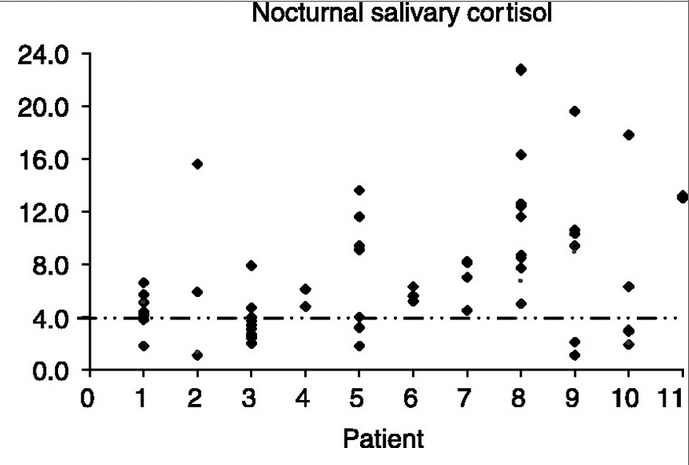
A fairly recent testing protocol, late-night salivary cortisol (NSC), is often touted as a replacement for the late-night serum cortisol. The ease of use at home has made it a practical application for testing cortisol levels. It, too, has limitations in testing for cyclic and/or mild CS.

A third application, the dexamethasone suppression test (DST), is another standard by which practioners evaluate their patients for CS. Again, there are limitations when evaluating cyclic/mild CS.

In a recent study, the full text article examines the three tests mentioned above. They found UFC's were of limited value whe diagnosing "mild" CS.

However, UFC may not accurately reflect the cortisol secretory state in patients with even the modest impairment of renal function (8). In addition, most of the cortisol secreted during a 24-h period is between 0400 h and 1600 h. Subtle increases in nighttime secretion, as may be seen in mild CS, may not be detected or only intermittently detected in a 24-h urine collection.

Notice the majority of the tests fell below the "normal" line on the graph.


In turn, the NSC was more accurate, but there were many "normals" in the results, with multiple repeats with several patients before obtaining a "high" result. The authors speculate this is due to cyclic CS or a "variability around a mildly elevated set point."

Of the 11 patients evaluated, all had surgery, and 10 of the 11 had pathology proven CS. (Sometimes it is hard to get enough sample tissue for a decent pathology with pituitary surgery.)
The DST was evaluated in this same study with those patients who were tested via that means, but not all patients were. However, in another study, the use of the DST was found to be of limited value for those patients with cyclic/mild CS.

These results demonstrate that the great majority of patients with mild and/or periodic Cushing's syndrome suppress to overnight dexamethasone. Since patients with mild and/or periodic Cushing's syndrome are the patients in whom the identification of hypercortisolism is difficult, our results from this relatively small study suggest that this test should no longer be used to exclude these patients from further workup for Cushing's syndrome.
It is important to remember that no one test adequately evaluates a patient for Cushing's. Even more important, multiple tests may have to be repeated multiple times. The authors in the first article emphasize this when they say, "Obviously [NSC and UFC ] may need to be performed several times before the suspected diagnosis of endogenous hypercortisolism can be correctly identified."

Still a third study (Findling, et al) says, "Even more problematic is the interpretation of the results of these tests, particularly if they are not in agreement with each other. This is particularly so in mild Cushing's syndrome; if the symptoms are subtle, the biochemical abnormalities are likely to be subtle as well." This is a very long article, chock full of information.

How important is it to screen for "mild" CS? "Mild" is a misleading term, sometimes more appropriately called subclinical CS. Findling, et al, point out a huge population where CS is generally overlooked and the depressing mortality for those same folks.

Why is this? Findling lists many reasons, including a study done by Cartagi, et al, where an extraordinarily large percentage of diabetic patients actually had CS. It is often too easy to pin a diagnosis of diabetes or hypertension without realizing it is a symptom.
The recognition of mild/subclinical and cyclic CS has changed the diagnostic approach. Sadly, too many patients are never seen by those who know that.
~~~~~~~~~~~~~~~~~~~~~~
(For more information on how these tests are done, see Testing 101: Biochemical analysis.
For problems/errors to watch for when testing, see When lab tests don't rate an A+, or even a C-..... )


Kidambi, S., Raff, H., Findling, J.W. (2007). Limitations of nocturnal salivary cortisol and urine free cortisol in the diagnosis of mild Cushing's syndrome. European Journal of Endocrinology, 157(6), 725-731. DOI: 10.1530/EJE-07-0424

Wednesday, July 9, 2008

Testing 101: Testing Growth Hormone Levels in Adults

12 responses

Ok...what's the big deal, anyhow? Why would anyone need to have their growth hormone levels evaluated? I'm going to stick to adults today because low growth hormone (GH) is a whole 'nuther ballgame with children.

As a review, growth hormone is secreted by the pituitary gland. Some pituitary tumors secrete too much GH which causes gigantism in children and acromegaly in adults. However, on the flip side, some tumors suppress the pituitary and too little is secreted. Even if the tumor does not do that, surgery to remove a tumor may cause the pituitary to quit or lessen it's secretion of GH. Radiation is also used on pituitary tumors that cannot be totally removed or if there is hyperplasia, and it, too, can damage the pituitary.

Adult Growth Hormone Deficiency (GHD) is a very real problem. GH maintains a healthy balance of muscle, bones, and fat and if an adult is deficient, her body composition changes. The body has less muscle, visceral fat is deposited around the abdomen, and bones weaken. Other fats in the body are affected. "Good" cholesterol (HDL) decreases but "bad" cholesterol (LDL) increases. This is very hard on the cardiovascular system (remember, the heart is a muscle) and the cerebrovascular system.

In Diagnosis of adult GH deficiency [V. Gasco, et al, Pituitary (2008) 11:121–128], the authors state:

Adults with growth hormone deficiency (GHD) have impaired health, which improves with GH replacement. GHD in adults leads to impairment in body composition and function, as well as to deranged lipoprotein and carbohydrate metabolism and increased cardiovascular morbidity. Based on evidence that GHD in adults is a
new syndrome which may benefit from GH replacement, health authorities in many countries have approved the therapeutic use of GH in hypopituitaric patients with severe GHD.

Not only is the physical health of a GHD adult affected. Social isolation, excessive tiredness, anxiety, depression, and apathy are also symptoms of GHD.

Ok, all of that to get to the testing part! Whew!

Growth hormone secretion is pulsatile which means random measurements of GH levels are not helpful or diagnostic. Since insulin-like growth factor-1(IGF-1) is stimulated by GH but does not fluctuate during the day like GH, it is useful in monitoring GH levels. Low levels are an excellent indication of a GHD problem. However, normal levels do not mean there is no deficiency.


The Growth Hormone Research Society met in 2007 in Australia and penned a consensus statement about the problems, testing, and treatments associated with adult GHD. In their consensus statement, they write:

...the patient with objective evidence of hypothalamic–pituitary disease (e.g., on imaging or after irradiation), who may present with organic isolated GHD as the first hormonal deficiency...may account for up to 25% of cases of GHD in the adult.

Consensus guidelines for the diagnosis and treatment of adults with GH deficiency II[European Journal of Endocrinology (2007) 157 695–700]

In this same consensus statement, they say:

Not all patients suspected of having GHD,however, require a GH stimulation test for diagnosis.Patients with three or more pituitary hormone deficiencies and an IGF-I level below the reference range have >97% chance of being GHD, and therefore do not need a GH stimulation test.

The Insulin Tolerance Test has, in the past, been the "gold-standard" for measuring true GHD. However, there have been some problems with its reproducibility and specificity.

In Clinical Presentation and Diagnosis: Growth Hormone Deficiency in Adults the American Journal of Managed Care [Volume 10:S424-S430 , October 2004 , Number 13 Suppl ] states:

Numerous pharmacologic agents can be used to assess GH production and secretion
by the pituitary in adults (Table 3). These include insulin, arginine, levodopa
(L-dopa), arginine plus L-dopa, arginine plus GHRH, and the glucagon test. None
display perfect sensitivity and specificity; however, the insulin tolerance test
(ITT) and arginine-GHRH are excellent tests.
The arginine-GHRH test is being used by major pituitary centers around the world. It is less stressful with less risk for the patient but yields reproducible and accurate results.

What are the differences in these two tests? In the ITT, the pituitary is provoked to produce GH by causing hypoglycemia in the patient with insulin. With the A-GHRH test, arginine is a somatostatin antagonist which essentially does the same thing. Combined with GHRH (to stimulate GH production), it is now the test of choice (see article linked above).

I had the arginine-GHRH stimulation test done this past spring at the University of North Carolina. There aren't many places to have this done on the east coast, yet. An IV was placed in my veins (after many attempts....I'm such a hard "stick") prior to the test. I had GHRH injected via an IV push, then Arginine was infused over a period of 30 minutes. My blood was drawn every 30 minutes afterwards for 3 hours and sent to Mayo Clinic labs to be tested. I received the following email a couple of weeks later, and my results were sent to my endocrinologist.

"You are definitely growth hormone deficient. Your starting GH value was 0.02ng/ml and your peak value was 0.13ng/ml."

I wasn't surprised. Neither was my endo.

Saturday, July 5, 2008

Testing 101: An introduction, Part II

0 responses
Yesterday I wrote mainly about pituitary tumors and their hormones, and how they were involved in testing. Today, I want to include information about adrenal tumors.

The adrenal glands sit on top of the kidneys and are sometimes called suprarenal glands. The adrenal gland is actually two glands that are fused together into one gland. Their triangular shape is composed of two main layers as a result: cortex and medulla.

The adrenal medulla produces two main chemicals called catecholamines: epinephrine (also called adrenaline) and norepinephrine. Both of these chemicals are involved in regulation of the nervous system. Epinephrine controls the short-term stress response (aka fight-or-flight response) with the help of norepinephrine, which is also involved in the regulation of mood.

The outer part of the adrenal gland, also called the adrenal cortex, produces steroid hormones that are involved in regulating a number of different body functions. Mineralocorticoids (such as aldosterone) help regulate the salt levels in the body by controlling the absorption and excretion of salt and water in the kidneys which is important in the regulation of blood pressure. Glucocorticoids (such as cortisol) regulate sugar and fat stores within the body, act as a strong anti-inflammatory force, and play an important role in fetal development, particularly in lung maturation. The adrenal cortex also produces several sex steroid hormones, including androgens (critical for male sexual development) and precursors to estrogen (critical for female sexual development).

Tumors of the adrenal glands arise from the cortex or the medulla part of the adrenal gland. Most are found during CT scans or other imaging for various reasons. Others are found due to the effects of the oversecretion of the chemicals or hormones they produce.

A benign tumor called an adrenal adenoma is the most common and is sometimes called an “incidentaloma” if it is not causing any hormonal or chemical oversecretions. However, there is a newer line of research which indicates these are not to be taken lightly and may be a result of other endocrine malfunctions. Marc Slawik and Martin Reincke write in Endotext.com:

In a study patients with incidentalomas who were suffering from subclinical Cushing´s syndrome (SCCS) were significantly more obese (17). In addition, patients with incidentalomas more frequently suffer from diabetes mellitus type 2 (2, 5) and it has been postulated that in these individuals hyperinsulinism leads to an increased proliferation of adrenal cells (25). Taking these findings together there seems to be a clear association of incidentalomas with features of the metabolic syndrome (obesity, arterial hypertension, NIDDM, dyslipidemia, dyscoagulation).

Just this week I linked to a news article which said:

The study, lead by Dr. Leslie Eldeiry, a clinical instructor at Harvard Medical School, which was conducted at Harvard Vanguard Medical Associates, found that"only 30 percent of patients underwent biochemical evaluation for adrenal hyperfunction," which is the production of excessive amounts of hormone.

In 2002, the National Institutes of Health released guidelines recommending hormonal evaluation of all incidentally discovered adrenal masses. Despitethe 2002 NIH recommendations, only 30 percent of patients were properly tested. Moreover only 18 percent of patients in the study who did not see an endocrinologist with adrenal nodules had hormonal testing.

(New Research Indicates That Adrenal Nodules Not Being Adequately Evaluated )

The most common malignant tumors found in the adrenal gland are tumors that come from cancer cells that have metastasized (or spread) from other parts of the body to the adrenal gland through the blood stream.

Rarely, cancers can arise directly within the adrenal glands themselves. Cancers of the adrenal cortex are called adrenal cortical cancers. Functioning adrenal cortical cancers (they secrete excess steroid hormones) are more common than non-functioning cancers.

The most common cancer of the medulla are pheochromocytomas. In children, neuroblastoma tumors can develop within the adrenal medulla.

On my next installment, I'll start talking about some of the testing that is done and what hormones/steroids/chemicals are measured.

Thursday, July 3, 2008

When lab tests don't rate an A+, or even a C-.....

1 responses
When testing for Cushing's, there are some standard tests that most up-to-date, in-the-know endocrine centers/doctors abide by. Of course, when one gets into the current research, combines the complexities of mild/episodic/cyclic Cushing's with florid/classical (you know...the CIA operative "thang" I've mentioned before), and then adds a dash ton of no-one-uses-the-same-protocols, no wonder it gets confusing.

The Urinary Free Cortisol (UFC) test has long been touted as the "gold standard". The current concensus among those who test episodic (et al) Cushing's the most is that it is NOT, but for the sake of argument and time, let's go with it. Everyone being tested for Cushing's will have to do UFC's. You are a rare one if not.

The UFC is a 24-hour collection of urine. That part is pretty easy. You discard the first void, start timing from there and collect every single pee-pickin' drop (I know...it's "pea"...couldn't resist) for those 24 hours, ending at the same time you started. What happens to that urine is the big debate, both before and after collection. My endocrinologist and at least two other major endocrinologists who are experts in the field recommend refrigeration if it's not going to the lab immediately (and possibly even then) but NO PRESERVATIVE.

Well, getting labs to agree to that is like the debacle in D.C. right now over Medicare. It ain't gonna happen. The absolute no-no that I've been told over and over is hydrochloric acid (HCl) as a preservative. Boric acid is accepted by most labs. Acetic acid is mentioned occasionally. In a study done by ARUP Institute, they found "Cortisol concentrations in samples stored with the acids were higher by 30% than in samples stored without acid, possibly as a result of partial hydrolysis of sulfate and glucuronide conjugates. " Esoterix, the diamond of endocrine labs, prefers no preservative at all.

What is a UFC measuring anyway? Well, "free" cortisol is used by the body for various functions, but the thought behind the test is that this free cortisol is spilled into the urine if there is excess. One can get into the effect of cortisol binding globulin (CBG) and all sorts of other scenarios which make that not true for many folks, but I won't in this post. So, if there is excess free cortisol spilled into the urine, an average can be measured for a 24-hour period.

UFC's are not just used to measure cortisol, though. Most endocrinologists also want to test the amount of creatinine in the urine, and many want to also test 17-hydroxycorticosteriods (17-OHC's). When that is the case, now the lab protocol must include them and determine if a preservative and which preservative is necessary or optional.

Also, the type of testing determines preservative use. Radioactive immunoassay (RIA) is now outdated, but is still being used. HPLC Tandem Mass Spectrometry is the most current, with Liquid Chromatography Tandem Mass Spectrometry (LCMSMS) running a close second.

I can tell tales about labs and how they handle this urine. Bacteria degrade the cortisol quickly at room temperature, and getting a lab to refrigerate it is a crap shoot (pee shoot?). You hope they will but often they don't. Measure/aliquoting a correct sample is another problem if there is more than one jug for a collection. I often collected more than one jug when my cortisol was high. The aliquot must be a mix of all samples so there is a proper average and the TOTAL volume for all jugs used in the 24-hour collection has to be recorded.

Some won't accept the collection if it doesn't have the what the person who is working at that time thinks is the correct preservative. I've been known to leave with my jugs in tow, call the lab manager, and go back when s/he is there. God forbid my hard work is wasted. Sadly, I have many friends with Cushing's who have had collections wasted due to inadequacy and nonunderstanding of proper protocols. Not MISunderstanding, mind you. NONunderststanding.

From experience and observation, I offer my humble opinion: Find a lab which will use one of the preferred methods above (not RIA), will refrigerate the urine until tested, will not add a preservative, and which understands all must be THAWED and MIXED before aliquoting it. If the urine aliquot/sample is sent elsewhere, it needs to be sent FROZEN to be thawed before measured, and the total amount of urine that was presented needs to be recorded.

Another test that is used extensively for the measurement of cortisol, especially with diurnal variation or lack of, is serum cortisol. This one is pretty straight forward as long as the person reading the lab results understands what they really mean.

The article, "Cushing's Syndrome" by John Newell-Price, Xavier Bertagna, Ashley B Grossman, Lynnette K Nieman, Lancet 2006; 367: 1605–17,Division of Clinical Sciences, University of Sheffi eld, Northern General Hospital, Sheffi eld, UK (J Newell-Price FRCP); says

An awake midnight concentration of cortisol in plasma of more than 207
nmol/L differentiates between Cushing’s syndrome and other causes of
hypercortisolaemia but can miss mild disease diagnosis in about 7% of cases.
(The conversion factor of μg/dL x 27.6 = nmol/L)


Essentially, serum cortisols only have valid ranges for the 8 a.m. and 4 p.m. time periods in most labs. The research and leading endocrinologists acknowledge the validity of midnight serum cortisols, also. So, as I said before, the 8 a.m. should be the highest of the three, with the 4 p.m. about half of the 8 a.m. value. The midnight value should be close to zero.

The problem is that the labs don't know about the midnight range (uh...zero), so IF one can find a lab willing to draw a midnight serum cortisol fairly frequently for testing, they won't know to put "zero" on the range and flag it as high if it's above that. 7.5 μg/dL (207 nmol/L) is diagnostically high. If you have someone ordering tests for you who does not understand this, you may get a call saying "it was normal". Ask for the actual report.

As for the bloodwork itself, it should be drawn into a red-top or green-top tube. However, all is not lost if another tube is used. Most of the time, it can be used anyhow for this test. Temperature really isn't a factor if the test is run in a timely manner. The serum needs to be separated from the cells and the sample cannot be anticoagulated. If it's not run within an hour, this should be done and the serum refrigerated up to 24 hours or frozen if longer.

A third test that is important in the diagnosing of Cushing's and differentiating between types is Adrenocorticotropic Hormone (ACTH). The lab technician must use an EDTA (lavender top) plasma tube only! Collection in nonsiliconized tubes can result in falsely low results as ACTH adheres to glass. It needs to be mixed by inversion and centrifuged immediately after collection. IT MUST NOT GET WARM. The tubes should be on ice prior to drawing the blood, and put immediately back in the ice until it is separated and then frozen. The plasma must be separated and frozen immediately. If it is shipped, it should be shipped on dry ice while still frozen. ACTH breaks down easily in heat, and if not collected and preserved on ice, proteolysis (degradation of proteins by cellular enzymes) can reduce the plasma concentration.

The salivary cortisol test is another test used very similarly to the serum cortisol tests. It, too, can help show diurnal rhythm (or lack thereof). The protocol is pretty simple and straight-forward regardless of the lab. There are only a few labs who use an FDA approved test for these salivary cortisol levels. The labs are Esoterix, ACL Laboratories, LabCorp (who now owns Esoterix), and Quest. It is very easy for a doctor to set up an account with any of these and order the testing kits for patients. The patient simply collects "spit" until s/he gathers enough for the container or "salivette". Some of the labs use a tampon-like material (salivette) for the patient to soak with saliva and place in the tube. Both methods of collection are reliable. However, it is important that one does not touch the salivette with hands and should not eat, drink or rinse the mouth for thirty minutes prior to collection.

A word of caution. Although the cortisol supposedly does not break down very quickly, a number of us got much higher results when we first froze the samples, then shipped them overnight. Since bacteria will break down cortisol, it stands to reason this can happen with the salivary test, too.

Another inconsistency with salivary cortisols that many of us have observed is that we have had high serum cortisols the same nights we have done salivary cortisols. I did several while sitting and having blood drawn. My serum cortisol was high. My salivary cortisol was "normal". Only when my serum cortisol (at midnight) was around 16 μg/dL or higher did my salivary cortisol show high levels, too. The clearance is different, thus the outcomes can vary.

What advice do I have for testing? You must be proactive in your testing process.
  • Know the proper protocols

  • Take print-outs of the proper protocols with you. You can find them for just about any lab. If you can't, the Mayo site and ARUP labs have great details. Labcorp and Esoterix also have may good, informative articles.

  • If your doctor wants it done a certain way, get him/her to put that in writing

  • Insist on the proper protocol. This is YOUR TIME and YOUR MONEY (even with insurance) that is paying for a service to be done right. You may need to catch that high and you don't want anyone to mess it up.

  • Call the lab ahead of time and speak with the lab manager. Explain your situation courteously and ask if they are familiar with the tests and protocols. Go over them together, talk about when you will be in, and what you need to do to make sure those protocols are followed. This will save you many headaches down the road. A good relationship with your lab will go a LONG way.

  • Call the lab manager again if you do encounter problems and discuss the issues. Courtesy still goes further than anger. However, I've been known to use some of that southern "charm" my mother taught me. Ahem...

  • For midnight serums, it is difficult to find a lab, other than the local hospital lab, open late at night. Again, call them ahead of time, explain the testing protocol and why you need to come in at midnight. Get the paperwork done ahead of time so you can go in and get it done quickly once you are there.

  • A little kindness goes a long way. A treat, some cookies, a gift basket or something simple as a cake shared with the lab folks occasionally will brighten their day. The late-night lab I used was full of readers. I saw good books everywhere, so I took in a stack every now and then after I'd finished them along with some candy or something.

  • Say thank-you when it is done right. Again, that goes a long way.

Don't be surprised if drawing blood is difficult. If you are one of the Cushies who has issues with that due to the affect of the cortisol on the veins, try to keep your arms warm and stay hydrated. My blood draws were very difficult on the best of days, and I was prepared for that. Warm bags of rice, a warm fleece jacket, or whatever it takes to keep those arms warm are helpful.

Well, the report card isn't in on the labs, yet, because the rubric hasn't been standardized, but you get an A for effort!!!



Tags

101 (6) 2009 (1) ACTH (3) addison's (2) adenoma (10) adrenal (6) adrenal adenomas (2) adrenal insufficiency (8) adrenalectomy (1) androgens (2) anger (1) animals (1) antibiotic (1) apathy (1) apnea (1) arginine (1) attitude (2) awareness (19) bacteria (1) bariatric (4) bilateral adrenalectomy; zebra (2) BLA (6) blog carnival (1) blogging (1) blogtalkradio (1) blood work (1) buffalo hump (1) cancer (1) carcinoma (1) cardiovascular (2) change (1) chronic (1) chronic illness (8) circadian (2) classical (1) cold (2) conn's (1) cortef (1) corticosteriod (2) cortisol (7) CSF (1) CT scan (1) cure (1) cushing (1) cushing's (77) cyberchondriac (2) cyclic (2) data (1) database (1) death (4) depression (1) dexamethasone (1) diabetes (3) diabetes insipidus (1) diagnose (1) diagnosis (10) disease (1) diurnal (2) doctor (3) doctor blogs (21) doctor friedman (1) doctors (2) doctors google (1) drugs (2) dynamic MRI (2) ectopic (2) education (1) EHR (1) EMR (1) endocrine (5) endocrinology (1) epatients (5) epigenetics (4) epinephrine (1) episodic (2) estrogen (1) familial (2) fat (1) fatigue (1) ferritin (2) florid (1) flu (1) fluid control (1) food (1) gadolinium (2) galactorrhea (1) gamma knife (3) genetics (3) genotropin (1) gland (1) google (1) google health (1) googling (2) grand rounds (4) growth hormone (13) guest post (1) headache (2) health care system (14) health records (4) healthcare (1) HIPAA (1) hirsutism (1) holiday (4) home (1) hoofbeats (1) hormone (1) hormones (5) hormones bioidentical (1) HRT (1) hurt (1) hypercortisolism (1) hyperplasia (1) hypertension (1) hyperthyroidism (2) hypoparathyroidism (1) hypopitiutarism (4) hypothalamus (2) hypothyroidism (7) iatrogenic (1) ice crunching (1) illness (3) imaging (4) immune (1) immunocompromised (1) infection (2) information (2) insurance (2) internet (1) invisible illness (1) iron (1) journey (2) ketoconazole (3) kidney (1) labs (2) lapband (1) laproscopic (1) levaquin (2) libido (1) macroadenoma (2) medical records (2) medical school (1) men (1) metabolic syndrome (3) metamorphosis (1) microadenoma (1) microscopy (1) mild (1) morbidity (2) mortality (1) MRI (2) MRSA (1) mucinex (1) neuroblastoma (1) news (10) night owl (1) nodules (1) norepinephrine (1) obesity (13) obesity hunger willpower (2) Occam's Blade (1) OFM (1) osteoporosis (2) pain (4) parathyroid (3) participatory medicine (2) pasireotide (1) patient rights (2) patients (7) patientsfirst (1) PCOS (6) PCP (1) pediatric (2) peer reviewed (1) percocet (1) personal (1) PET (1) phenotype (1) pheochromoctyoma (1) pheochromocytoma (1) PHR (3) pictures (1) pituitary (24) pituitary surgery (7) pituitary tumor adenoma research acromegaly (1) poll (1) polycystic (2) prolactinoma (1) protein (1) psychological (1) radiation (1) radio; cushing's (2) rant (1) recurrence (1) reform (2) relationships (1) remission (2) research (26) respect (1) retrospective (4) rocephin (1) safari (1) salivary (2) sarcoidosis (1) science (1) serum cortisol (1) shame (1) sick (1) sinus (1) sinus infection (2) sinusitis (1) sleep (2) soda (1) spoon theory (1) steriod (1) steroids (1) subclinical (2) surgery (11) surgeXperiences (2) survival (1) symptom (1) technology (1) temozolomide (1) testing (6) testosterone (2) thyroid (6) to google (1) top10 (1) transsphenoidal endoscopic (1) travel (2) treatment (3) trust (1) tumor (12) twitter (5) urinary free cortisol (2) urinary infection (2) UTI (1) veteran (1) video (3) Vitamin D (6) weakness (1) zebra (5) zippy (1)

Email me....

survivethejourney at gmail dot com

Subscribe via email

Enter your email address:

Delivered by FeedBurner